
California’s Daylighting Law: What Every Resident Must Know
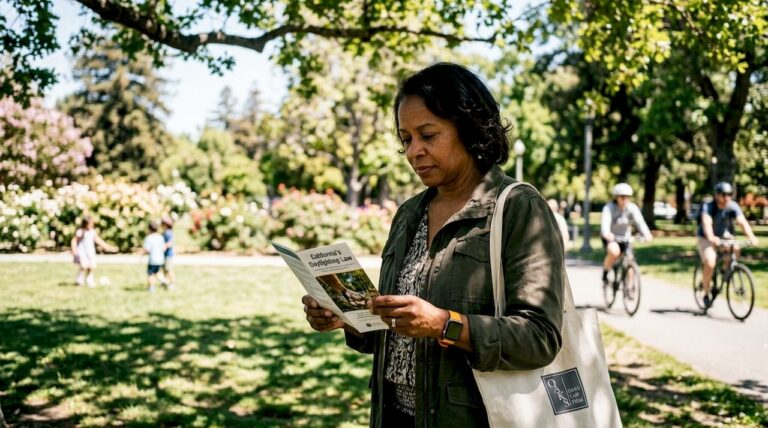
California’s Daylighting Law, enacted through Assembly Bill 413, makes it illegal to park, stop, or stand within 20 feet of any crosswalk in the state. The law took effect on January 1, 2025, and applies to every marked and unmarked crosswalk statewide under California Vehicle Code Section 22500(n). For California residents and property owners, understanding this regulation is no longer optional. Violations carry a $63 fine, and enforcement is active even where no red curb paint exists. This guide covers the exact rules, the safety data behind them, how enforcement works in practice, and what the law means for your property.
What Is California’s Daylighting Law and Why You Should Be Aware of It?
California’s Daylighting Law is defined as a statewide prohibition on parking within 20 feet of the approach side of any crosswalk, whether marked or unmarked. The term “daylighting” refers to keeping the sightline between drivers and pedestrians clear at intersections. When a parked vehicle sits too close to a crosswalk, it blocks a driver’s view of a person stepping off the curb. The result is a preventable collision.
Assembly Bill 413 codified this rule into California Vehicle Code Section 22500(n). The law is not a local ordinance. It applies uniformly across every city and county in California, from Los Angeles to Eureka. That statewide reach is what makes it different from earlier, patchwork local rules that only some cities enforced.
The safety rationale is direct. About 22% of all pedestrian fatalities in California in 2023 occurred at intersections, with some local areas reporting figures as high as 36%. That concentration of deaths at crossings is exactly what daylighting rules target. Removing parked vehicles from the zone closest to a crosswalk gives both drivers and pedestrians the visibility they need to react in time.
What are the exact parking restrictions under California’s Daylighting Law?
The core rule is straightforward. California’s Daylighting Law prohibits parking, stopping, or standing within 20 feet of the approach side of any marked or unmarked crosswalk. One exception applies: if a curb extension or “bulb-out” is present, the restricted distance shrinks to 15 feet because the physical structure already improves sightlines.
Here is what the law covers in plain terms:
- 20-foot rule: No vehicle may park, stop, or stand within 20 feet of the approach side of any crosswalk, marked or unmarked.
- 15-foot exception: Where a curb extension is physically present, the restricted zone is 15 feet from the crosswalk.
- Marked and unmarked crosswalks: The law covers both painted crosswalks and legal unmarked crosswalks at intersections, which exist at every intersection where two public roads meet at a right angle.
- No paint required: Violations are ticketed even when no red curb paint marks the zone. The absence of paint is not a legal defense.
- Fine: The current fine for a violation is $63.
- Enforcement authority: Any law enforcement agency in California may issue citations under this law.
The “approach side” language is specific. The restriction applies to the side of the crosswalk that vehicles approach before reaching the intersection, not the far side. That is the side where a parked car most directly blocks a driver’s view of a pedestrian stepping into the road.
Pro Tip: If you are unsure whether you are within 20 feet of a crosswalk, step off the curb and count your paces. Twenty feet is roughly six to seven adult steps. When in doubt, park farther away.
The absence of red paint is the detail that catches most drivers off guard. Many California residents assume that an unpainted curb is a legal parking spot. Under Assembly Bill 413, that assumption is wrong at any intersection. The law is self-executing. You do not need a sign or painted curb to be in violation.
How does daylighting improve pedestrian and road safety in California?
Parked vehicles near crosswalks create a specific type of hazard called a visibility blind spot. A driver turning right cannot see a pedestrian stepping off the curb if an SUV or delivery truck is parked at the corner. The pedestrian, in turn, cannot see the approaching vehicle. Both parties enter the intersection without the information they need to avoid a crash.
The numbers behind this problem are significant. Pedestrian fatalities at intersections account for 22% to 36% of all pedestrian traffic deaths in California, depending on the area. That share is disproportionately high given that intersections represent a small fraction of total road distance. Clearing the 20-foot zone directly addresses the most dangerous moment in any pedestrian’s crossing: the first step off the curb.
Vision Zero, the traffic safety framework adopted by cities including Los Angeles, San Francisco, and San Jose, identifies intersection visibility as a primary target for reducing pedestrian deaths. Daylighting is one of the core tools in that framework. The logic is simple: you cannot react to what you cannot see.
“Hardened daylighting,” which uses physical barriers like bollards, concrete bulb-outs, or planters, is significantly more effective at improving pedestrian safety than paint alone. Paint-only daylighting may even encourage higher vehicle speeds at intersections because drivers feel less constrained by a visual marking than by a physical object.
The distinction between paint and physical infrastructure matters for how you evaluate the law’s real-world impact.
| Daylighting method | Visibility improvement | Parking compliance | Speed reduction |
| Paint only (red curb) | Moderate | Inconsistent | Minimal |
| Bollards or planters | High | High | Moderate |
| Concrete bulb-outs | High | Very high | High |
Hardened daylighting infrastructure, such as concrete bulb-outs or planters, also functions as a physical traffic calming measure. It slows turning vehicles and shortens the pedestrian crossing distance. Paint tells drivers where not to park. A bollard physically prevents it. The safety outcomes are not equivalent.
Pro Tip: When walking to a crosswalk, check for parked vehicles blocking your view before stepping off the curb. Even with daylighting rules in place, compliance is uneven. Look before you step.
The most dangerous cities for pedestrians in Southern California share a common feature: high-volume intersections with poor visibility. Daylighting rules directly target that condition.
What are common enforcement practices and local implementation challenges?
Enforcement of California’s Daylighting Law is active but uneven across the state. The Los Angeles County Sheriff’s Department began issuing citations in june 2026, with the $63 fine applying immediately. Other agencies began enforcement earlier, following the law’s january 1, 2025 effective date.
The practical challenge for many cities is physical marking. Here is how enforcement and compliance vary across California:
- Berkeley has painted red curbs at nearly 1,700 intersections to comply with the law, making it one of the most aggressive early adopters. Active citation enforcement is in place.
- Palo Alto has stalled on enforcement, citing budget and staffing constraints. Some cities issued warnings before moving to citations.
- Oakland and other cities face similar delays, with red curb painting incomplete in many neighborhoods.
- Los Angeles County began formal citation enforcement through the Sheriff’s Department in 2026, prioritizing school zones and high-pedestrian corridors.
- Statewide rule, local execution: Every city must comply with the law, but the speed and completeness of curb painting varies widely based on municipal resources.
The most important practical point for residents is this: the law does not require a painted curb to be enforceable. Enforcement officers measure parking distance from crosswalks directly when no visual curb markings exist. A driver who parks 15 feet from an unmarked crosswalk can receive a $63 citation even if the curb is plain gray concrete.
Cities are prioritizing enforcement in school zones, downtown corridors, and areas with documented pedestrian injury histories. If you park near any intersection in California, the 20-foot rule applies regardless of what the curb looks like. Checking your distance from the nearest crosswalk is now part of responsible parking.
The LA County Sheriff’s Department has been active in communicating pedestrian safety rules to the public, including daylighting requirements. Staying informed through official agency communications is the most reliable way to track local enforcement timelines.
How does the Daylighting Law affect property owners and urban development?
Property owners near intersections face direct consequences from California’s Daylighting Law. The 20-foot restriction removes legal parking spaces from the street in front of or adjacent to private property. For owners of multi-unit residential buildings, retail storefronts, or commercial properties near crosswalks, that loss of street parking is real and immediate.
The key impacts for property owners include:
- Reduced street parking inventory: Properties at or near intersections lose the parking spaces closest to the corner. In dense urban neighborhoods, those spaces are often heavily used.
- Development planning: New construction projects adjacent to intersections must account for daylighting zones in site planning. Driveways, loading zones, and parking layouts near crosswalks require review against California Vehicle Code Section 22500(n).
- Curb extension installations: Cities installing physical bulb-outs may permanently alter the curb line in front of adjacent properties. Property owners have limited ability to object to these public right-of-way changes.
- Property value considerations: Reduced street parking near a property can affect tenant satisfaction and commercial foot traffic, particularly in neighborhoods where off-street parking is scarce.
- Influence on local implementation: Property owners can engage with city planning departments and local traffic safety committees to provide input on where hardened daylighting infrastructure is installed.
| Property type | Primary impact | Recommended action |
| Residential near intersection | Loss of corner street parking | Notify tenants; review off-street options |
| Retail storefront at crosswalk | Reduced customer parking | Engage city planning for loading zone review |
| New development adjacent to crosswalk | Site plan compliance required | Consult with a land use attorney |
| Multi-unit building near school zone | Priority enforcement area | Communicate rules to residents |
Urban planners view daylighting as a net positive for neighborhood safety, but parking loss concerns make widespread community acceptance complex. The tension between safety improvements and parking demand is real in high-density California cities. Property owners who understand the law can plan around it rather than be caught off guard by citations or infrastructure changes.
The California car accident laws for 2026 include several provisions that interact with daylighting rules, particularly around liability at intersections. Property owners and developers benefit from understanding how these rules connect.
Key Takeaways
California’s Daylighting Law requires every driver and property owner near an intersection to know the 20-foot parking restriction, because enforcement is active statewide and citations apply even without painted curbs.
| Point | Details |
| Core rule | No parking within 20 feet of any crosswalk, marked or unmarked, under California Vehicle Code Section 22500(n). |
| Fine and enforcement | The $63 fine applies statewide; red curb paint is not required for a citation to be issued. |
| Safety rationale | Intersection pedestrian fatalities account for 22%–36% of California’s total, making visibility the central safety issue. |
| Hardened vs. painted daylighting | Physical barriers like bollards and bulb-outs outperform paint alone in reducing pedestrian injuries and vehicle speeds. |
| Property owner impact | Properties near intersections lose corner street parking and must account for daylighting zones in development planning. |
Injured near a crosswalk? Oakslawfirm can help
Intersection accidents cause some of the most serious injuries in California, and the legal questions that follow are rarely simple. When a driver’s view is blocked, when a pedestrian is struck in a crosswalk, or when a property condition contributes to a crash, determining liability requires experience and a thorough investigation.
At Oakslawfirm, attorney Matthew Nezhad and his team represent injured victims throughout the and across California. If you or someone you know was hurt near an intersection, understanding how to file a personal injury lawsuit is the first concrete step. Oakslawfirm accepts a limited number of cases each year and works on a no-fee guarantee basis, meaning you pay nothing unless the firm wins your case. Contact Oakslawfirm today for a free case evaluation.
Legal Disclaimer: This article is for general informational purposes only and does not constitute legal advice. Reading this article does not create an attorney-client relationship with Oaks Law Firm or any of its attorneys. The information provided may not reflect the most current legal developments and may not apply to your specific situation. Laws vary by jurisdiction and change over time. Do not act or refrain from acting based on anything you read in this article without seeking qualified legal counsel. If you have a legal problem, contact a licensed attorney in your jurisdiction. Past results do not guarantee future outcomes. Oaks Law Firm is a personal injury law firm serving clients in California.
FAQ
What is California’s Daylighting Law?
California’s Daylighting Law, enacted through Assembly Bill 413, prohibits parking, stopping, or standing within 20 feet of the approach side of any marked or unmarked crosswalk statewide. It took effect on January 1, 2025, under California Vehicle Code Section 22500(n).
Does the law apply even if there is no red curb paint?
Yes. Violations are enforceable regardless of whether a red curb or signage is present. Enforcement officers measure distance from the crosswalk directly when no paint exists.
What is the fine for violating California’s Daylighting Law?
The fine is $63 per violation. The Los Angeles County Sheriff’s Department began issuing citations in june 2026, and other agencies enforce the same fine statewide.
How does the 15-foot exception work?
Where a physical curb extension or bulb-out is present at an intersection, the restricted zone is 15 feet instead of 20 feet. The physical structure itself improves sightlines, which is why the shorter distance applies.
How does this law affect property owners near intersections?
Property owners near crosswalks lose legal street parking in the 20-foot zone adjacent to their property. New developments must account for daylighting restrictions in site planning, and cities may install physical bulb-outs in the public right-of-way without requiring property owner approval.
Recommended
- California Car Accident Laws 2026: Know Your Rights
- California Injury Claim Time Limit: What You Must Know
- Statute of Limitations in California for Car Accidents
