

Causation in an accident claim is the legal requirement that directly connects a defendant’s negligent act to the injuries you suffered. Without it, even the most obvious negligence does not create liability. California courts, like courts across the country, require you to prove two distinct types of causation: actual cause and proximate cause. Both must be established before any compensation is possible. Understanding this two-part framework is the single most important concept in personal injury law for anyone considering or already involved in an accident claim.
What is causation in an accident claim, exactly?
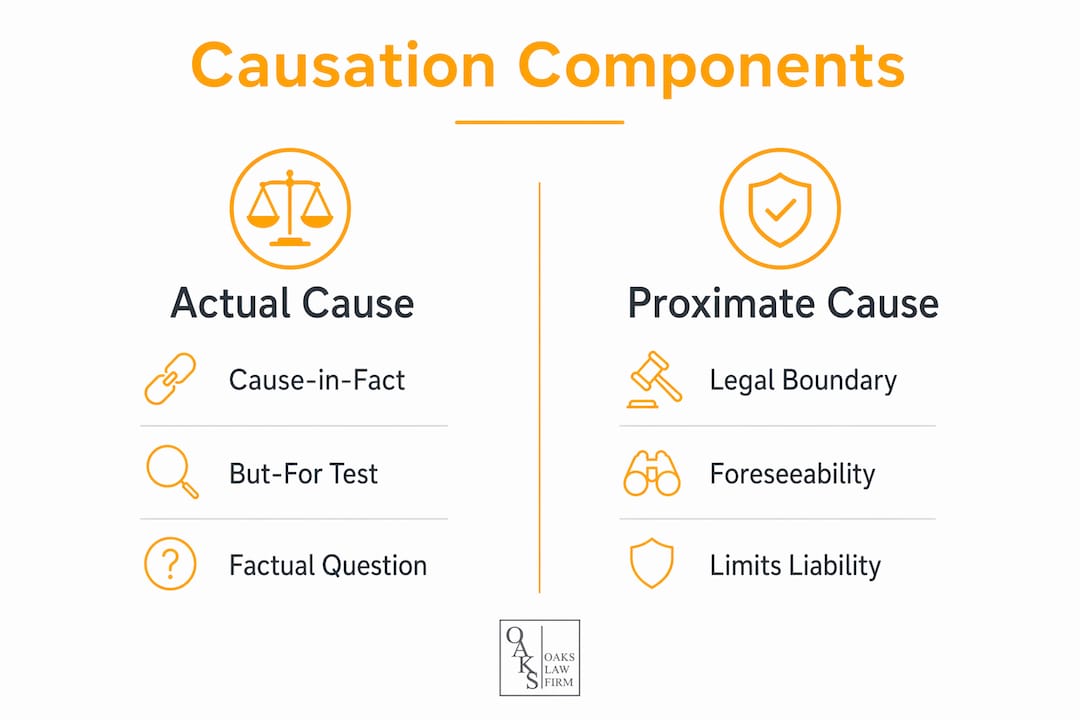
Causation in negligence claims requires proving both actual cause and proximate cause. These two elements form the backbone of every personal injury case, and neither one alone is enough.
Actual cause, also called cause-in-fact, answers a simple factual question: would your injury have happened if the defendant had acted safely? Courts apply what is known as the “but-for” test to answer it. The but-for test asks whether the injury would have occurred if the defendant had acted safely. If the answer is no, actual causation is proven. A driver who runs a red light and hits your car passes this test immediately. Your injury would not have happened but for that driver’s decision to ignore the signal.
Proximate cause is the second requirement, and it operates as a legal boundary. Proximate cause limits liability to harms that are a reasonably foreseeable consequence of the defendant’s conduct. Liability does not extend to remote or bizarre results, even when factual causation exists. If a driver rear-ends your vehicle and you suffer whiplash, that injury is foreseeable. If that same collision somehow triggered an unrelated chain of events injuring someone three blocks away, proximate cause would likely cut off the driver’s liability at some point.
The practical stakes are real. Proving causation shapes legal outcomes substantially. Failure to prove it means dismissal of your claim, even if the defendant’s negligence is beyond dispute.
How do actual cause and proximate cause work together?
The two types of causation serve different functions, and courts analyze them separately. Think of actual cause as the factual foundation and proximate cause as the legal filter applied on top of it.
Here is how each one works in practice:
- Actual cause (but-for test): You prove the defendant’s conduct was the factual trigger for your injury. Without that conduct, no injury occurs.
- Proximate cause (foreseeability test): You prove the type of harm you suffered was a reasonably foreseeable result of the defendant’s behavior. Courts focus on the general category of harm, not the exact details.
- Both must be satisfied: A claim fails if either element is missing. You can have clear factual causation but still lose if the harm was too remote or unforeseeable.
- Foreseeability is forward-looking: Proximate cause focuses on foreseeability from the defendant’s perspective at the time of the act, not in hindsight. A reasonable person should anticipate the type of harm their conduct risks, not its precise occurrence.
- Intervening acts can break the chain: Intervening or superseding acts can sever the causal chain if they are sufficiently independent and unforeseeable. Courts assess whether a subsequent event shifts responsibility away from the original defendant.
A concrete example clarifies the interaction. A property owner fails to fix a broken staircase railing. A visitor falls and breaks an arm. Actual cause is clear: but for the broken railing, no fall occurs. Proximate cause is also clear: a fall and physical injury are exactly the foreseeable result of a defective railing. Both elements are satisfied, and the claim moves forward.
Now change the facts slightly. The same visitor falls, and while being transported to the hospital, the ambulance is struck by a drunk driver. The original property owner is not liable for injuries caused by the ambulance crash. That second collision is an independent, unforeseeable event that breaks the causal chain.
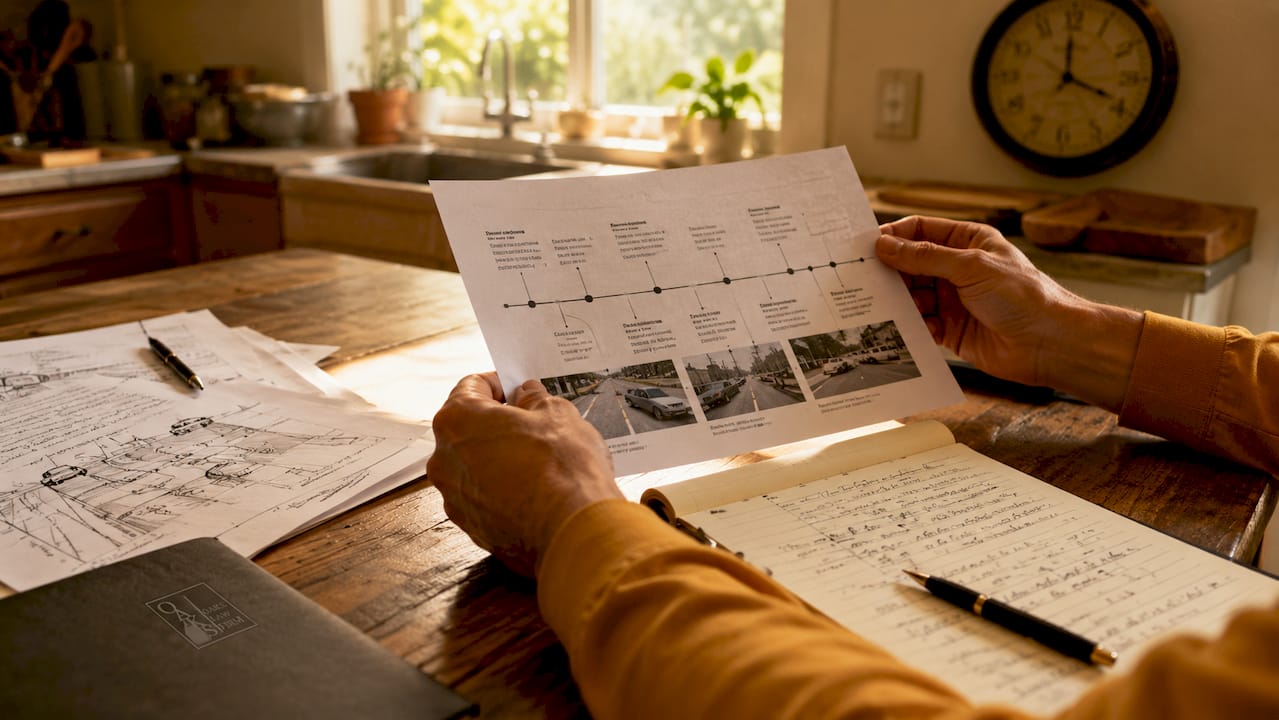
Pro Tip: Document the exact sequence of events immediately after any accident. The timeline you create on day one becomes the factual foundation for your actual cause argument later.
How do courts handle multiple causes or multiple defendants?
Complex accidents often involve more than one negligent party, and the but-for test can break down in those situations. California courts recognize this limitation and apply alternative frameworks.
The core challenge looks like this:
- Two drivers both run stop signs and collide into your vehicle simultaneously. You cannot prove which driver’s conduct was the but-for cause of your specific injuries.
- A construction site has three contractors, all of whom violated safety codes. A falling object injures a worker, but the exact source is unclear.
- Multiple manufacturers produce a defective product, and the specific unit that caused harm cannot be identified.
In these situations, courts turn to the substantial factor test. Under this standard, a defendant’s conduct is a cause of injury if it was a substantial factor in bringing about the harm, even if other causes also contributed. This test is broader than the but-for test and is particularly useful in multi-defendant cases.
California also recognizes alternative liability, a doctrine established in the landmark case Summers v. Tice. In that case, two hunters both negligently fired in the plaintiff’s direction, and one pellet struck him. Since the plaintiff could not identify which hunter fired the injuring shot, courts used burden-shifting to require each defendant to prove they were not the cause. When multiple negligent actors cause an indivisible injury but the exact cause is unknown, burden-shifting doctrines help plaintiffs prevail.
| Scenario | Test Applied | Effect on Plaintiff |
|---|---|---|
| Single defendant, clear cause | But-for test | Standard proof required |
| Multiple defendants, unclear cause | Substantial factor test | Broader causation standard |
| Indivisible injury, multiple actors | Alternative liability | Burden shifts to defendants |
| Intervening act by third party | Superseding cause analysis | Original defendant may be absolved |
Pro Tip: If your accident involved multiple vehicles or parties, tell your attorney every detail about each party’s conduct. Facts that seem minor can determine which causation doctrine applies and whether your claim succeeds.
What evidence proves causation in an accident case?
Establishing causation in accidents requires more than telling your story. Courts demand concrete, organized evidence that connects the defendant’s conduct to your specific injuries.
The most important categories of proof include:
- Medical records with clear timelines: Your medical records must show that your injuries appeared immediately after or shortly following the accident. Gaps in treatment give defendants ammunition to argue your injuries came from another source.
- Expert medical testimony: Medical expert testimony is often crucial to link specific injuries to the accident and explain causation scientifically. Diagnosis alone rarely suffices. Experts explain the causal mechanism and rule out alternative causes.
- Accident reconstruction reports: In vehicle collisions, reconstruction experts can establish the physics of the crash and connect the forces involved to your documented injuries.
- Photographs and video evidence: Visual documentation of the scene, vehicle damage, and your physical condition immediately after the accident supports both actual and proximate cause arguments.
- Witness statements: Independent witnesses who observed the accident and its immediate aftermath corroborate the factual sequence of events.
Defendants do not sit quietly while you build your case. Defendants often challenge causation at the medical level using treatment gaps or pre-existing condition arguments. If you had a prior back injury and now claim the accident worsened it, expect the defense to argue your current pain is entirely pre-existing.
The standard you must meet is the preponderance of the evidence. Plaintiffs must prove causation by a preponderance of the evidence, meaning more likely than not. You do not need absolute certainty. You need to convince the factfinder that it is more probable than not that the defendant’s conduct caused your injury. That is a 51% threshold, not a 100% one.
Courts rely on medical timelines and expert coherence to resolve disputes, especially when injuries have delayed onset or multiple contributing factors. A clear, consistent medical history is the single most powerful tool for establishing causation successfully.
Seeing a doctor immediately after your accident is not just good health practice. It is a legal strategy. Every day you wait creates a gap that the defense will exploit. A guide on documenting injuries after a car accident can help you understand exactly what records to gather and preserve from day one.
How does proving causation affect your compensation?
The practical impact of causation on your claim is direct and significant. Causation is not a procedural formality. It is the mechanism that determines whether you receive any compensation at all.
Here is how causation shapes real outcomes:
- No causation means no claim. A defendant can be 100% negligent, and you can still walk away with nothing if you cannot connect that negligence to your specific injuries. Courts have dismissed cases where liability was obvious but causation was not proven.
- Proximate cause defines the scope of damages. The foreseeability requirement in proximate cause directly limits what you can recover. You can only claim compensation for harms that fall within the foreseeable range of the defendant’s conduct. Unforeseeable consequences are off the table.
- Causation strength affects settlement value. Insurance adjusters and defense attorneys evaluate causation when calculating settlement offers. A claim with airtight causation evidence commands a higher settlement than one with gaps or disputed medical timelines. Understanding why personal injury cases settle starts with understanding how causation affects the defense’s risk calculation.
- Pre-existing conditions complicate but do not eliminate claims. California follows the “eggshell plaintiff” rule. A defendant takes you as they find you. If your pre-existing condition was aggravated by the accident, you can still recover for that aggravation. You must prove the accident caused the worsening, not just the underlying condition.
- Expert testimony often determines the outcome. In cases where causation is disputed, the quality and credibility of your medical expert can be the deciding factor between a full recovery and a dismissed claim.
Understanding how causation affects claims also helps you set realistic expectations before you file. If your medical evidence is strong and the causal link is clear, your position in negotiations is strong. If there are gaps, an experienced attorney can help you address them before the defense does.
Key takeaways
Causation is the legal bridge between a defendant’s negligence and your right to compensation, and proving it requires both factual and legal elements working together.
| Point | Details |
|---|---|
| Two-part requirement | Both actual cause and proximate cause must be proven for any claim to succeed. |
| But-for test is the starting point | Courts first ask whether the injury would have occurred without the defendant’s conduct. |
| Foreseeability limits liability | Proximate cause cuts off liability for harms that no reasonable person could have anticipated. |
| Evidence quality is decisive | Medical records, expert testimony, and consistent timelines are the core tools for proving causation. |
| Causation drives compensation | A strong causal link increases settlement value; a weak one gives defendants grounds to deny the claim entirely. |
What i’ve learned about causation after two decades of cases
Most people who come to me after an accident understand that someone acted carelessly. What surprises them is learning that carelessness alone is not enough. Causation is where cases are won and lost, and it is the element that gets underestimated most often.
The biggest mistake I see is delayed medical treatment. Someone feels sore after a crash, assumes it will pass, and waits two weeks to see a doctor. By then, the defense has a two-week gap to exploit. They will argue the injury happened elsewhere, or that it is not serious enough to warrant compensation. That gap costs claimants real money.
The second thing I have learned is that proximate cause is far more complex than most people expect. Clients sometimes want to claim every negative consequence that followed an accident, including things that are genuinely connected in their minds but legally too remote to recover. Being honest about the foreseeable scope of harm early in a case saves everyone time and frustration.
Expert testimony is where I have seen the most dramatic swings in case outcomes. A well-prepared medical expert who can explain the causal mechanism clearly, rule out alternative explanations, and withstand cross-examination is worth more than almost any other piece of evidence. I always invest time in finding the right expert for each case, because a weak expert can undermine an otherwise strong claim.
My advice to anyone reading this: get medical attention immediately, document everything, and do not assume your case is straightforward just because the other party was clearly at fault. Causation requires proof, and proof requires preparation.
— Matthew Nezhad
Oakslawfirm can help you prove causation in your claim
Oakslawfirm has spent over two decades representing accident victims throughout the and California, with a focused practice on cases where causation is contested. Lead attorney Matthew Nezhad and his team know how to build the medical timelines, secure expert witnesses, and counter the defense tactics that target causation gaps.

Whether you suffered neck injuries after a car accident or are dealing with complex passenger injury claims involving multiple defendants, Oakslawfirm has the experience to connect the facts to the law. The firm accepts a limited number of cases each year, which means every client receives focused attention. Contact Oakslawfirm today for a free case evaluation and find out exactly where your causation argument stands.
FAQ
What is causation in a personal injury claim?
Causation is the legal requirement that connects a defendant’s negligent conduct to your specific injuries. Courts require proof of both actual cause and proximate cause before liability is established.
What is the but-for test in accident claims?
The but-for test asks whether your injury would have occurred if the defendant had acted safely. If the answer is no, actual causation is proven and the analysis moves to proximate cause.
How does proximate cause differ from actual cause?
Actual cause is a factual question about what triggered the injury. Proximate cause is a legal question about whether the harm was a foreseeable result of the defendant’s conduct, and it limits how far liability extends.
What standard of proof applies to causation?
You must prove causation by a preponderance of the evidence, meaning it is more likely than not that the defendant’s conduct caused your injury. Absolute certainty is not required.
Can a pre-existing condition stop you from proving causation?
No. Under California’s eggshell plaintiff rule, a defendant is liable for aggravating a pre-existing condition. You must prove the accident worsened your condition, not that it caused the original injury.
This article is provided for general informational purposes only and does not constitute legal advice. The information presented may not reflect the most current legal developments and should not be relied upon as a substitute for consultation with a licensed attorney. Every personal injury case involves unique facts and circumstances, and the outcome of any case depends entirely on those specific facts. Any results, settlement amounts, or verdicts referenced in this content are specific to the individual cases described, are not typical, and do not guarantee, promise, or predict a similar outcome in your case. Reading this content does not create an attorney-client relationship with Oaks Law Firm. Contact us directly for a consultation specific to your situation.
