

Hiring a personal injury attorney is the single most effective step you can take to maximize your compensation after an accident caused by someone else’s negligence. Attorney-represented claimants recover roughly 3 to 3.5 times more than unrepresented claimants, net of attorney fees, according to Insurance Research Council closed-claim data. That difference translates to an average of $10,000 without a lawyer versus $35,000 with one. Beyond the financial upside, attorneys manage evidence, negotiate with insurers, calculate full damages including future medical costs, and protect you from missing California’s 2-year filing deadline under California Code of Civil Procedure § 335.1. Most attorneys handle these cases on contingency, meaning you pay nothing upfront and owe fees only if you recover compensation.
Why hire a personal injury attorney: the compensation data
The financial case for hiring an attorney is not a matter of opinion. It is documented in closed-claim studies. Represented claimants receive settlements averaging 3 to 3.5 times higher than unrepresented claimants, and a Martindale-Nolo survey found that figure reaches 4.4 times higher in some case categories. That gap persists even after you subtract attorney fees.
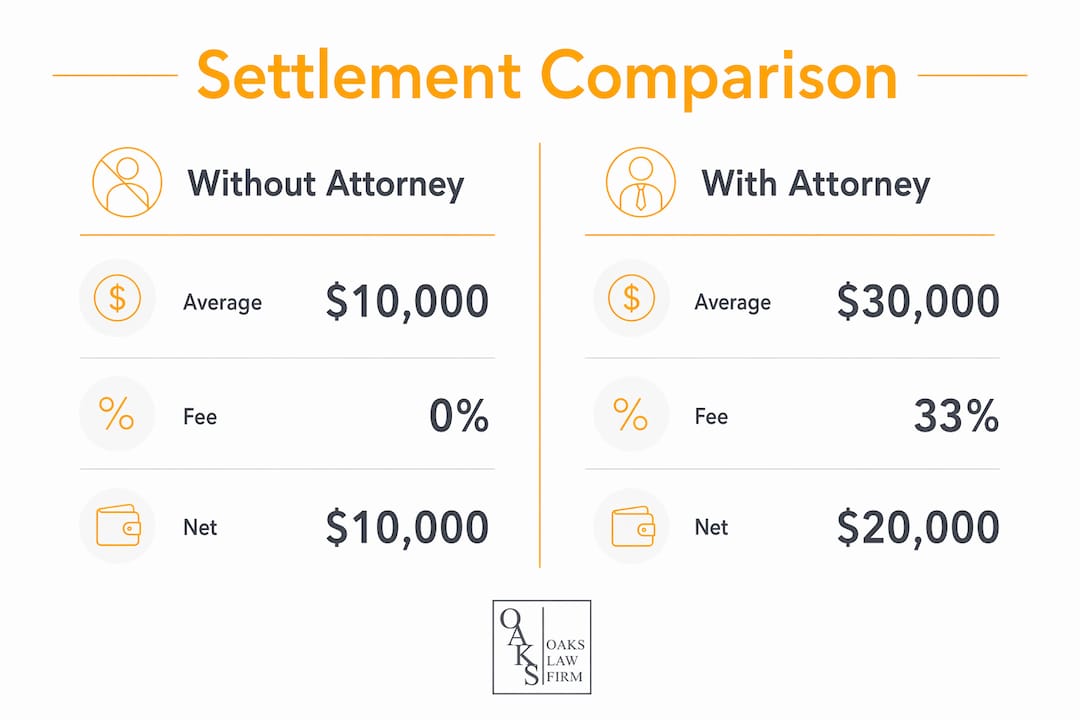
Here is what the numbers look like in practice:
| Scenario | Average settlement | Attorney fee (33%) | Net recovery |
|---|---|---|---|
| No attorney | $10,000 | $0 | $10,000 |
| With attorney (3x multiplier) | $30,000 | $9,900 | $20,100 |
| With attorney (3.5x multiplier) | $35,000 | $11,550 | $23,450 |
| With attorney (4.4x multiplier) | $44,000 | $14,520 | $29,480 |
Hiring an experienced personal injury attorney often results in a significantly higher overall settlement generally 3 to 5 times (and sometimes much more) than what the average person is able to negotiate on their own.
- With an attorney: You pay nothing out of pocket. The attorney advances all costs and expenses while handling your case. They only get paid if they successfully recover money for you.
- Handling the case yourself: You are responsible for negotiating directly with the insurance company, managing all medical bills and liens, dealing with paperwork, deadlines, and potential collections all while recovering from your injuries. This often leads to a much lower final amount in your pocket and far more stress.
Because attorneys know how to value claims, counter insurance tactics, and negotiate medical reductions, their involvement typically delivers a much stronger net result for you even after their contingency fee.
Pro Tip: If an insurer contacts you within days of an accident with a settlement offer, treat it as a signal that your claim is worth more than they are offering. Consult an attorney before signing anything.
What does a personal injury attorney actually do for your claim?
Most people assume a personal injury lawyer’s job is to argue in a courtroom. In reality, attorney work is primarily about claim valuation and management, not litigation. The majority of personal injury cases settle before trial, which means the attorney’s leverage comes from building a claim so well-documented that the insurer has no incentive to fight it.

Here is what that looks like day to day:
Evidence management:
- Collecting police reports, medical records, and emergency room documentation
- Preserving surveillance footage and photographs before they are deleted or overwritten
- Securing witness statements while memories are still accurate
- Retaining accident reconstruction experts when fault is disputed
Damage calculation:
- Calculating current medical bills and projecting future treatment costs
- Documenting lost wages and reduced earning capacity
- Quantifying non-economic damages like pain and suffering, which insurers routinely undervalue
- Building claims that include future medical needs and wage loss proof to differentiate settlements between similar injuries
Insurance negotiation:
- Handling all direct communication with adjusters so you cannot be recorded making damaging statements
- Countering lowball offers with documented evidence rather than emotional appeals
- Identifying bad-faith delay tactics and applying legal pressure when necessary
Litigation preparation:
- Filing suit when settlement negotiations stall, which itself often prompts better offers
- Managing procedural deadlines, discovery, and court filings
The practical benefit of this comprehensive role is that you focus on recovering from your injuries while the attorney focuses on recovering your compensation. That division of labor is one of the most underappreciated advantages of personal injury attorneys.
Pro Tip: Schedule your attorney consultation within the first week after an accident. Surveillance footage is often overwritten within 30 to 72 hours, and early attorney involvement locks down evidence that would otherwise disappear.
When do you actually need an attorney vs. handling it yourself?
Not every personal injury situation demands full legal representation. The honest answer is that case complexity determines necessity. Understanding where your situation falls on that spectrum helps you make a realistic decision.
Situations where hiring an attorney is the right call:
| Factor | Why it matters |
|---|---|
| Serious or permanent injuries | Higher damages require precise calculation; errors are costly |
| Disputed fault | Insurers exploit ambiguity to reduce or deny claims |
| Multiple liable parties | Coordination between insurers and defendants requires legal skill |
| Insurance delays or denials | Attorneys recognize bad-faith tactics and have legal tools to counter them |
| Pre-existing conditions | Insurers use medical history to minimize payouts; attorneys rebut this |
| Government entity involved | Special notice requirements and shorter deadlines apply |
Situations where self-representation may be feasible:
Minor injuries with a clear recovery timeline, unambiguous liability, and a cooperative insurer sometimes allow for straightforward negotiation. If your total damages are under a few thousand dollars and the other party’s fault is undisputed, the math on attorney fees may not favor representation. Small claims court handles disputes up to $12,500 in California without requiring an attorney.
The risk of handling complex claims alone is not just a lower settlement. It includes missing legal deadlines, accepting releases that waive future claims for injuries that worsen, and failing to identify all liable parties. These are not recoverable mistakes. A free initial consultation with a personal injury attorney near me or in your area costs nothing and gives you a professional assessment of which category your case falls into.
How contingency fees work and why they remove the cost barrier
The contingency fee structure is the reason why hiring an attorney is financially accessible to virtually every injury victim, regardless of income. California personal injury attorneys typically charge between 33% and 40% of the recovery, with the exact percentage depending on case complexity and whether the case settles before or after a lawsuit is filed.
Here is how the structure works in practice:
- No upfront payment. You owe nothing to retain the attorney or for any work performed before resolution.
- Fee is percentage-based. If your case settles for $60,000 at a 33% rate, the attorney receives $19,800 and you receive $40,200.
- Higher complexity, higher percentage. Cases that go to trial typically carry a 40% fee because of the additional time and resources involved.
- Costs are separate from fees. Filing fees, expert witness costs, and deposition expenses are typically advanced by the attorney and reimbursed from the settlement. Clarify this structure at your initial consultation.
- No recovery means no fee. The contingency structure means the attorney’s financial interest is directly aligned with yours. They earn more when you earn more.
This alignment of incentives is significant. An attorney working on contingency has every reason to document your damages thoroughly and push for the highest possible settlement. A flat-fee or hourly arrangement would not create the same motivation. The no-fee guarantee model also means that financial barriers to representation are effectively eliminated for injury victims who have a viable claim.
You can review Oakslawfirm’s no-fee guarantee policy for a clear explanation of how this works in practice before your first meeting.
Why acting quickly after an accident protects your entire claim
Timing is one of the most consequential decisions you make after an injury. California law sets a strict 2-year statute of limitations for personal injury claims under California Code of Civil Procedure § 335.1. Miss that deadline and your claim is permanently barred, regardless of how strong the evidence is.
But the statute of limitations is not the only timing risk. Here is a practical post-accident checklist that protects your claim before you even speak to an attorney:
- Seek medical treatment immediately. Gaps in treatment give insurers grounds to argue your injuries were not serious or were caused by something else.
- Document the scene. Photograph injuries, vehicle damage, road conditions, and any visible contributing factors.
- Get witness contact information. Names and phone numbers collected at the scene are far more reliable than trying to track people down weeks later.
- Request the police report. Obtain the report number and follow up to get the full document within days.
- Preserve all communications. Save every text, email, and voicemail from the other party or their insurer.
- Avoid recorded statements. Insurers often request recorded statements early. Decline until you have spoken with an attorney.
- Schedule a legal consultation. Contact a personal injury attorney within the first week, even if you believe the case will settle easily.
Evidence deteriorates quickly after an accident. Witnesses forget details, surveillance footage gets deleted, and physical evidence disappears. Attorneys who are brought in early can send preservation letters to businesses, retain investigators, and lock down records that would otherwise be lost. The difference between a claim filed at month one and month eleven is often the difference between a strong case and a weak one.
For California-specific timing rules, Oakslawfirm has a detailed breakdown of the injury claim time limit that covers exceptions and special circumstances worth knowing before your consultation.
Key takeaways
Hiring a personal injury attorney produces significantly higher net compensation than self-representation, and the contingency fee structure makes that advantage accessible to virtually every injury victim with a viable claim.
| Point | Details |
|---|---|
| Higher net recovery | Represented claimants recover 3 to 4.4 times more, even after attorney fees are deducted. |
| No upfront cost | Contingency fees of 33% to 40% mean you pay nothing unless you win your case. |
| Evidence preservation | Early attorney involvement secures surveillance footage, witness statements, and records before they disappear. |
| Legal deadline risk | California’s 2-year statute of limitations bars claims permanently if missed, making prompt action critical. |
| Attorney role is practical | Most attorney work involves claim valuation, evidence management, and negotiation, not courtroom appearances. |
What 20 years of injury cases taught me about going it alone
I have spent my entire legal career representing injured people in the and throughout California. The pattern I see most often is not dramatic courtroom battles. It is people who waited too long, accepted the first offer, or tried to handle a complex claim themselves and discovered the cost of that decision months later when it was too late to fix.
The most common mistake I see is underestimating the insurer’s preparation. By the time an adjuster calls you, they have already reviewed the police report, pulled your prior claims history, and calculated a number designed to close your file. They are not your advocate. They are a professional negotiator working for the other side.
What changes when an attorney gets involved is the information balance. Insurers anchor offers based on partial evidence. When we document the full treatment history, project future medical costs, and present a complete picture of economic and non-economic losses, the negotiation starts from a completely different baseline. I have seen cases where the initial offer was $8,000 and the final settlement exceeded $75,000, not because we went to trial, but because we built a claim the insurer could not credibly dispute.
The other thing I tell every potential client is this: the contingency fee structure means you have nothing to lose by getting a professional opinion. A free consultation does not commit you to anything. But it gives you an accurate picture of what your claim is actually worth, which is information you cannot get from the insurer offering you a check.
If your injuries are serious, your fault is disputed, or you are dealing with an insurer who is delaying or minimizing your claim, the data and my experience point in the same direction. Get representation early.
— Matthew Nezhad
How Oakslawfirm can help you recover what you deserve

Oakslawfirm has represented injured victims in the and throughout California since 2002, with a deliberate focus on accepting a limited number of cases each year so every client receives the attention their case requires. Lead attorney Matthew Nezhad and his team handle all aspects of personal injury claims on a contingency fee basis, meaning you pay nothing unless the firm recovers compensation for you. Whether you were injured in a car accident, a slip and fall, or any other negligence-related incident, the firm offers a free initial case evaluation with no obligation. If you are ready to understand your legal options and what your claim may be worth, learn more about filing a personal injury lawsuit in Los Angeles or contact Oakslawfirm directly to schedule your consultation.
FAQ
How much more money do you get with a personal injury attorney?
Represented claimants recover 3 to 4.4 times more than unrepresented claimants on average, and that advantage holds even after deducting contingency fees of 33% to 40%.
What questions should I ask a personal injury lawyer at the first meeting?
Ask about their experience with cases similar to yours, the likely value range of your claim, their contingency fee percentage, and whether any additional costs like filing fees come out of the settlement separately.
Can I handle a personal injury claim without an attorney?
Self-representation is feasible for minor injuries with clear liability and small damages, but serious injuries, disputed fault, or insurer delays significantly increase the risk of undervaluation and procedural mistakes.
How long do I have to file a personal injury claim in California?
California’s statute of limitations gives you 2 years from the injury date to file a personal injury claim under California Code of Civil Procedure § 335.1. Missing this deadline permanently bars your claim.
Do personal injury attorneys charge upfront fees?
Most California personal injury attorneys work on contingency, meaning no upfront fees are required and you only pay if the attorney recovers compensation on your behalf.
This article is provided for general informational purposes only and does not constitute legal advice. The information presented may not reflect the most current legal developments and should not be relied upon as a substitute for consultation with a licensed attorney. Every personal injury case involves unique facts and circumstances, and the outcome of any case depends entirely on those specific facts. Any results, settlement amounts, or verdicts referenced in this content are specific to the individual cases described, are not typical, and do not guarantee, promise, or predict a similar outcome in your case. Reading this content does not create an attorney-client relationship with Oaks Law Firm. Contact us directly for a consultation specific to your situation.
