

A slip and fall claim is a legal action under premises liability law that allows an injured person to recover compensation when a property owner’s negligence caused unsafe conditions leading to their injury. The legal framework requires proving four elements: duty of care, breach of that duty, causation, and measurable damages. Common scenarios include wet grocery store floors, broken staircase steps, uneven sidewalks, and icy parking lots. Understanding the slip and fall claim process is the difference between walking away with fair compensation and leaving money on the table. This guide covers evidence, negligence standards, realistic settlement ranges, and exactly how to file.
What evidence is necessary to support a slip and fall claim
Strong evidence is the foundation of every successful premises liability case. Without it, your word stands against the property owner’s insurer, and insurers are trained to win that argument.
The most critical categories of evidence include:
- Photographs and video of the hazard. Take photos immediately at the scene, before anything is cleaned up or repaired. Capture the exact condition that caused your fall, the surrounding area, and any warning signs (or the absence of them).
- Medical records from day one. Consistent medical documentation is the spine of your damages claim. A gap in treatment gives adjusters a reason to argue your injuries were not serious or were caused by something else.
- Witness names and contact information. Bystanders who saw the fall or knew about the hazard beforehand are valuable. Get their information before you leave the scene.
- An official incident report. Report the fall to the property manager, store supervisor, or building owner before you leave. Request a copy of the written report.
- Your clothing and footwear. Preserving exact shoes and clothing counters a common insurance defense that argues your footwear caused the fall. Store them in a bag and do not wash them.
- Surveillance footage. This is your most powerful and most perishable asset. Most businesses overwrite footage every 30 to 72 hours. A spoliation or preservation letter sent to the property owner immediately after the incident is the only reliable way to stop deletion.
- Property maintenance and inspection records. These documents reveal whether the owner knew about the hazard or had a pattern of neglecting repairs.
The legal concept of constructive notice is worth understanding here. Constructive notice doctrine means a property owner can be held liable even without actual knowledge of a hazard, as long as the hazard existed long enough that a reasonable inspection would have found it. A puddle that sat for three hours before your fall is different from one that appeared two minutes earlier. Evidence of how long the hazard existed directly affects your ability to prove constructive notice.
Pro Tip: Send a preservation letter to the property owner within 24 hours of your fall. Address it to the owner, manager, and their insurance carrier. State clearly that you demand all surveillance footage, maintenance logs, and inspection records be preserved. This letter creates legal liability if they destroy evidence after receiving it.

How is negligence proven in a slip and fall claim, and what challenges arise
A fall alone does not entitle a victim to compensation. Negligence by the property owner must be proven, and that proof follows a four-part structure.
- Duty of care. The property owner owed you a legal duty to maintain safe premises. This applies to customers in retail stores, tenants in apartment buildings, and guests in private homes, though the standard varies by visitor category.
- Breach of duty. The owner failed to meet that standard. A wet floor with no warning sign, a broken step left unrepaired for weeks, or a parking lot with known ice patches all qualify as breaches.
- Causation. The breach directly caused your injury. This is where medical records linking your diagnosis to the fall become critical. Without that link, insurers argue your injury existed before the incident.
- Damages. You suffered measurable harm: medical bills, lost income, pain, or disability.
“A slip and fall case success often hinges on the clarity of the hazard and documented negligence rather than just the accident itself.” — legalgiant.co
How insurers challenge your claim
Property owner insurers are skilled at reducing payouts. Their most common tactics include arguing you were distracted, wearing inappropriate footwear, or ignored an obvious hazard. They also use comparative negligence rules to reduce your compensation based on your share of fault. In California, pure comparative negligence applies, meaning even if you are found 30% at fault, you recover 70% of your damages. Some states bar recovery entirely if your fault exceeds 50%.
Another challenge is insurance policy limits. Commercial property policies typically cover $1 million or more, while homeowner policies may cap out far lower. If your damages exceed the policy limit, collecting the full amount requires additional legal strategy.
Documented prior complaints about the same hazard are powerful counters to these defenses. If a store employee filed a maintenance request about a leaking refrigerator three days before your fall, that record proves the owner had actual notice and chose not to act.
What compensation can you expect from a slip and fall claim
Settlement amounts vary widely based on injury severity, evidence quality, and how clearly negligence is established.
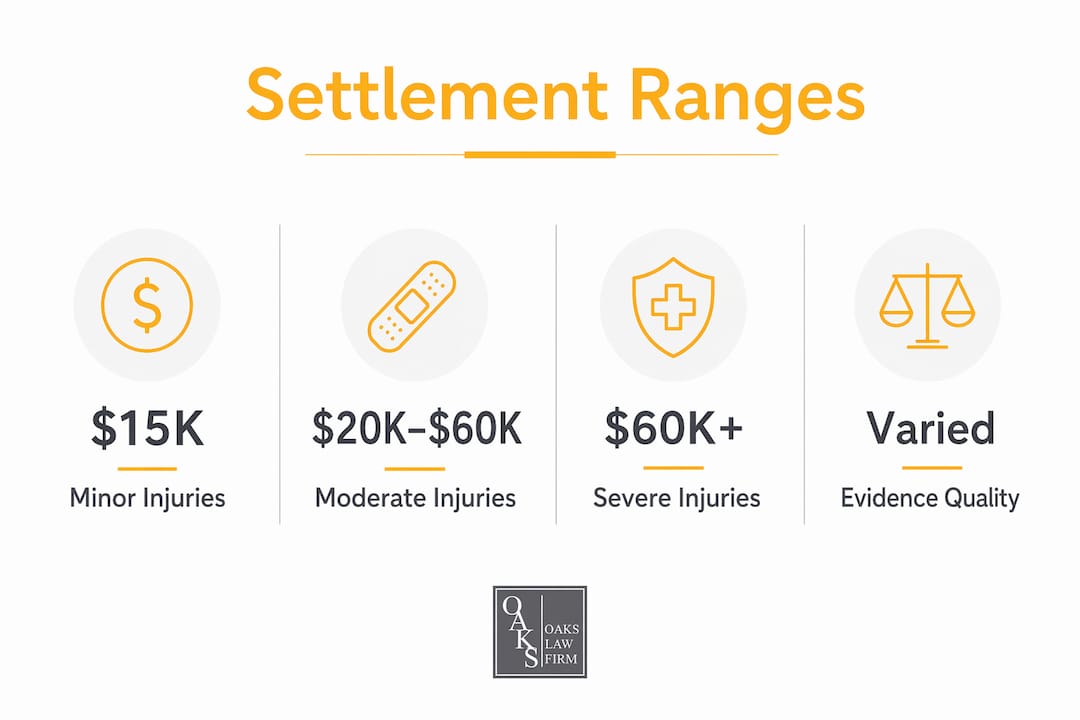
Average slip and fall settlements in 2026 typically range between $20,000 and $60,000 for moderate injuries. This means the majority of claims involving sprains, soft tissue damage, or minor fractures resolve in this range without going to trial.
| Injury Severity | Typical Settlement Range |
|---|---|
| Minor soft tissue injuries | Around $15,000 |
| Moderate injuries (fractures, back injuries) | $20,000 to $60,000 |
| Severe injuries (surgery required) | $125,000 to $400,000+ |
| Permanent disability or traumatic brain injury | $400,000 and above |
These figures reflect cases where negligence is reasonably clear. Weak evidence or significant comparative fault can push settlements toward the lower end or eliminate recovery entirely.
Types of damages you can recover
Slip and fall economic damages include medical care costs, lost wages during recovery, and future treatment expenses if your injury requires ongoing care. Non-economic damages cover pain and suffering, emotional distress, and loss of enjoyment of life. Courts and juries calculate non-economic damages differently, but injury severity and duration of recovery are the primary drivers.
Punitive damages are rare in slip and fall cases but possible when a property owner displayed reckless indifference to safety. A landlord who ignored repeated written complaints about a broken staircase railing for six months, for example, could face punitive exposure beyond compensatory damages.
Settlement amounts increase when video evidence clearly shows negligence and when defendants demonstrate reckless disregard for safety. A clear surveillance clip of a store employee mopping a floor, placing no wet floor sign, and walking away moments before your fall is worth more than any written argument.
Pro Tip: Never accept the first settlement offer from an insurer. Initial offers are almost always below the actual value of your claim. An attorney reviewing your medical records and evidence can give you a realistic floor before you negotiate.
What is the step-by-step process for filing a slip and fall claim
The legal process for slip and fall cases follows a predictable sequence, but timing errors at any stage can reduce or eliminate your recovery.
- Seek medical treatment immediately. Go to an emergency room, urgent care, or your physician the same day. Delayed treatment creates a gap that insurers use to argue your injuries were not caused by the fall.
- Report the incident officially. Notify the property owner or manager before leaving. Get the incident report number or a copy of the written report.
- Gather and preserve evidence. Photograph the scene, collect witness contacts, store your clothing, and send a preservation letter for surveillance footage within 24 hours.
- Consult a personal injury attorney. An attorney can evaluate your claim, identify liable parties, and handle communications with the insurer. Review the free consultation prep guide from Oaks Law Firm before your first meeting to arrive prepared.
- File a claim with the property owner’s insurer. Your attorney or you will submit a demand letter outlining your damages, supported by medical records and evidence.
- Negotiate a settlement. Most claims resolve at this stage. Insurers make counteroffers, and negotiations can take weeks to months depending on injury complexity.
- File a lawsuit if negotiations fail. If the insurer refuses a fair offer, your attorney files a civil complaint. Discovery, depositions, and potential trial follow.
Slip and fall claims typically settle within 12 to 24 months, though complex cases involving litigation can extend to three years. Cases that resolve early in negotiation move faster. Trials are the exception, not the rule.
Common mistakes that weaken your claim
Avoid these errors, as each one has cost real clients real money:
- Delaying medical treatment or skipping follow-up appointments
- Giving a recorded statement to the insurer without legal advice
- Posting about the accident or your injuries on social media
- Accepting an early settlement offer before understanding your full damages
- Failing to report the incident officially at the scene
These mistakes can reduce or eliminate potential payouts. Insurers monitor social media and use casual posts to argue you are not as injured as claimed. A photo of you standing at a family event two weeks after a back injury can undermine months of medical documentation.
One distinction worth noting: if you were injured at your workplace, your claim may fall under workers’ compensation rather than premises liability. Workers’ comp is a separate system with different rules, deadlines, and compensation structures. An attorney can clarify which path applies to your situation.
Key takeaways
A slip and fall claim succeeds when you prove the property owner’s negligence caused a specific, documented injury, and when you preserve the evidence to support that proof before it disappears.
| Point | Details |
|---|---|
| Negligence must be proven | A fall alone does not create liability; duty, breach, causation, and damages must all be established. |
| Evidence is time-sensitive | Send a preservation letter within 24 hours to protect surveillance footage before it is overwritten. |
| Settlements vary by injury severity | Minor injuries average around $15,000; severe cases with surgery can exceed $125,000 to $400,000. |
| Comparative fault reduces your payout | Your compensation decreases by your percentage of fault, so avoid actions that suggest shared responsibility. |
| Avoid early settlement offers | First offers from insurers are typically below claim value; consult an attorney before accepting anything. |
What I’ve learned after two decades of slip and fall cases
After more than 20 years handling personal injury cases in the , I can tell you that the cases we win most decisively are not necessarily the ones with the worst injuries. They are the ones where the client did the right things in the first 48 hours.
The single most overlooked step is the surveillance preservation letter. I have seen strong cases collapse because a client waited a week to call an attorney, and by then the footage was gone. Businesses do not save video out of goodwill. You have to demand it in writing, fast. That letter changes the legal dynamic immediately.
I also see clients undermine their own claims without realizing it. Posting a photo at a birthday party, skipping a physical therapy appointment because you felt better that day, or answering an adjuster’s call without counsel are all mistakes that show up later in settlement negotiations. Insurers are patient. They build files over months and use every inconsistency they find.
The other thing I want people to understand is that comparative fault is not a death sentence for your claim. California’s pure comparative negligence system means you can recover even if you were partially at fault. What matters is how clearly the property owner’s negligence is documented versus your own conduct. Clients who wore reasonable footwear, were not distracted, and reported the hazard immediately are in a much stronger position than those who cannot account for their own actions at the time of the fall.
My honest advice: treat the first 72 hours after a slip and fall the same way you would treat the first 72 hours after any serious legal event. Document everything, say as little as possible to the other side, and get professional guidance before you make any decisions about your claim.
— Matthew Nezhad
How Oaks Law Firm can help with your slip and fall case

Oaks Law Firm has represented injured victims throughout the and California for over two decades. Lead attorney Matthew Nezhad and his team handle a limited number of cases each year, which means every client receives focused, experienced attention. If you were injured in a slip and fall at a store, apartment complex, restaurant, or any other property in the Los Angeles area, the firm offers a free case evaluation with no obligation. Early contact protects your evidence and your legal rights. Reach out to the slip and fall attorneys at Oaks Law Firm today, or learn more about how injury compensation works in California before your consultation.
FAQ
What does a slip and fall claim require to succeed?
A successful slip and fall claim requires proving four elements: the property owner owed you a duty of care, they breached that duty, the breach caused your injury, and you suffered measurable damages. A fall alone does not create liability.
How long does a slip and fall claim take to resolve?
Most slip and fall claims settle within 12 to 24 months. Cases that proceed to trial can take up to three years, depending on court schedules and case complexity.
How much is a typical slip and fall settlement in 2026?
Moderate injury cases typically settle between $20,000 and $60,000. Severe cases involving surgery or permanent disability can exceed $125,000, with some reaching $400,000 or more depending on negligence clarity and evidence strength.
What should I do immediately after a slip and fall accident?
Seek medical treatment the same day, report the incident to the property owner or manager, photograph the hazard, collect witness contact information, and send a written preservation request for surveillance footage within 24 hours.
Does comparative negligence affect my slip and fall payout?
Yes. If you are found partially at fault, your compensation is reduced by your percentage of fault. In California, you can still recover damages even if you share some responsibility for the fall.
This article is provided for general informational purposes only and does not constitute legal advice. The information presented may not reflect the most current legal developments and should not be relied upon as a substitute for consultation with a licensed attorney. Every personal injury case involves unique facts and circumstances, and the outcome of any case depends entirely on those specific facts. Any results, settlement amounts, or verdicts referenced in this content are specific to the individual cases described, are not typical, and do not guarantee, promise, or predict a similar outcome in your case. Reading this content does not create an attorney-client relationship with Oaks Law Firm. Contact us directly for a consultation specific to your situation.
