

A car accident lawsuit is a civil legal action filed in court to seek compensation when insurance negotiations fail or produce an unfair result. Unlike a standard insurance claim, a lawsuit names a specific defendant and asks a judge or jury to award damages for medical bills, lost wages, and pain and suffering. Most people never expect to file one, but understanding the process before you need it is the difference between protecting your rights and losing them entirely.
What is a car accident lawsuit and how does it work?
A car accident lawsuit is defined as a civil case filed when an injured party seeks court-ordered compensation after insurance negotiations break down. It differs from an insurance claim in one critical way: it names a defendant directly and puts the dispute before a court, rather than leaving resolution in the hands of an adjuster. The damages sought typically fall into three categories: economic damages such as medical expenses and lost income, non-economic damages such as pain and suffering, and in rare cases, punitive damages when the defendant’s conduct was especially reckless.
The formal term attorneys use is “personal injury litigation,” though car accident lawsuit is the phrase most people search for and use in conversation. Both terms describe the same process. The lawsuit is not necessarily a sign that you are headed to trial. In practice, filing a lawsuit often functions as a pressure mechanism that compels insurance companies to negotiate more seriously. Many cases settle within weeks of a complaint being filed, once the insurer realizes the injured party is serious about pursuing full compensation.

California, where Oaks Law Firm operates across the San Fernando Valley, follows standard civil litigation rules that apply to most car accident cases in the state. Understanding those rules, and the timeline attached to them, gives you a meaningful advantage from day one.
What is the typical car accident lawsuit process?
The car accident lawsuit process follows a defined sequence of civil litigation stages, each with its own requirements and strategic importance. Knowing what comes next prevents surprises and helps you prepare.
1. Hiring an attorney and case evaluation
Before anything is filed, an attorney reviews the facts, assesses liability, and estimates damages. This step determines whether a lawsuit is worth pursuing and what legal theories apply to your case.
2. Filing the complaint
Your attorney drafts and files a formal complaint with the court, naming the defendant and stating the legal basis for your claim. The defendant is then served with the complaint and given a deadline to respond, typically 30 days in California.
3. The defendant’s answer
The defendant, usually represented by their insurer’s attorney, files an answer either admitting or denying the allegations. They may also file counterclaims or affirmative defenses at this stage.
4. Discovery
Discovery is the most time-consuming phase. Both sides exchange documents, request records, and take depositions. A deposition is sworn testimony given outside of court, and it carries the same legal weight as testimony at trial. Discovery is often the make-or-break phase because statements and documentation are rigorously tested here. Disorganized records or inconsistent statements can seriously damage a claim.
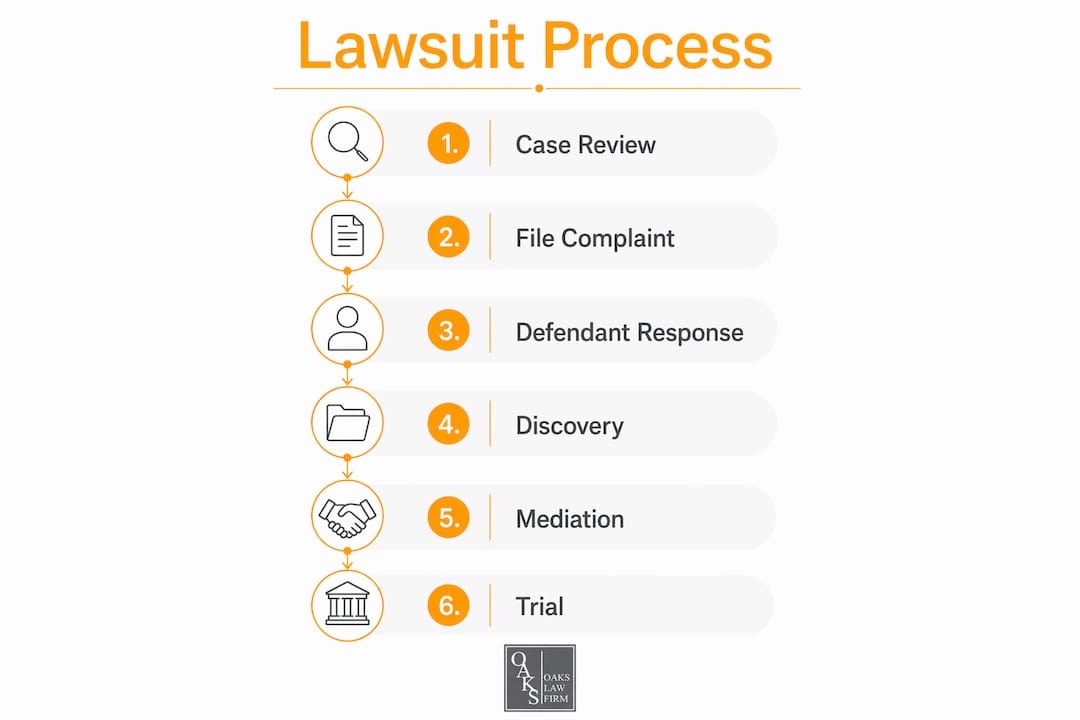
5. Mediation and settlement conferences
Courts in California routinely require parties to attempt mediation before scheduling a trial. A neutral mediator facilitates negotiation, and many cases resolve here. This step saves time and legal costs for both sides.
6. Trial
If mediation fails, the case proceeds to trial. A judge or jury hears evidence, evaluates witness testimony, and renders a verdict. Trial is relatively rare in car accident cases, but it remains a real possibility when liability is genuinely disputed or damages are significant.
Pro Tip: Start organizing your medical records, repair estimates, photos, and any written communication with insurers from the day of the accident. Attorneys at Oaks Law Firm consistently find that clients who arrive with organized documentation move through discovery faster and negotiate from a stronger position.
The full timeline from filing to resolution typically runs one to three years, depending on injury severity, the number of parties involved, and how aggressively the defense contests liability.
What are the deadlines for filing a car accident lawsuit?
Statutes of limitations for car accident lawsuits vary by state, typically ranging from two to three years, but can be as short as one year or as long as six years depending on jurisdiction. In California, the standard deadline to file a personal injury lawsuit after a car accident is two years from the date of the accident. Miss that deadline and the court will almost certainly dismiss your case, regardless of how strong your claim is.
The California statute of limitations for car accidents is detailed at Oaks Law Firm’s resource, and there are several exceptions worth knowing:
- Government defendants: If your accident involved a government vehicle or a public entity, you must file an administrative claim within six months of the accident, not two years.
- Minor plaintiffs: The two-year clock generally does not start until the injured person turns 18.
- Discovery rule: In rare cases where injuries were not immediately apparent, the clock may start from the date you discovered the injury, not the accident date.
- Tolling: Certain circumstances, such as the defendant leaving California, can pause the statute of limitations temporarily.
The most dangerous misconception about deadlines is that settlement negotiations pause the clock. Filing deadlines don’t pause for negotiations. The statute of limitations runs continuously, even while you and the insurer are exchanging settlement offers. Many injured people lose their right to sue entirely because they trusted that ongoing talks would protect them.
| Scenario | Deadline |
|---|---|
| Standard California car accident | 2 years from accident date |
| Accident involving a government vehicle | 6-month administrative claim deadline |
| Injured minor | 2 years from 18th birthday |
| Delayed injury discovery | 2 years from discovery date |
Pro Tip: Even if you are actively negotiating with an insurer, consult an attorney well before your deadline. Filing a lawsuit does not mean the case goes to trial. It simply preserves your legal rights while negotiations continue.
How do car accident lawsuits differ from insurance claims?
A car accident insurance claim and a car accident lawsuit are not the same thing, and confusing them is one of the most common and costly mistakes injured people make. An insurance claim is a request made directly to an insurance company, either your own or the at-fault driver’s, asking them to pay for your losses. A lawsuit is a formal legal action filed in court. The two processes can run in parallel, but they operate under entirely different rules.
Insurance companies deny or undervalue claims for several reasons: disputed liability, questions about whether the accident caused your specific injuries, or simply a strategy to minimize payouts. When that happens, a lawsuit converts the dispute from a private negotiation into a court-enforceable proceeding. The insurer can no longer simply ignore your demand letter.
Here is how the two processes compare directly:
| Factor | Insurance claim | Car accident lawsuit |
|---|---|---|
| Who decides the outcome | Insurance adjuster | Judge or jury |
| Formal legal process required | No | Yes |
| Binding on both parties | Only if accepted | Yes, once judgment is entered |
| Typical timeline | Weeks to months | One to three years |
| Damages available | Policy limits only | Full compensatory and punitive damages |
The decision to file a lawsuit often comes down to one question: is the insurer offering fair compensation? If the answer is no, and your injuries are serious, a lawsuit is frequently the only path to full recovery. Damages that are often unavailable through insurance alone include future medical costs, long-term lost earning capacity, and compensation for permanent disability or disfigurement. You can read more about how compensation works in California to understand what you may be entitled to.
What are the typical outcomes and how long do cases take?
Most car accident lawsuits do not go to trial. Courts actively encourage mediation, and the majority of cases settle before a jury ever hears the facts. Settlement is the most common resolution because it gives both sides certainty. The plaintiff receives compensation without the risk of a jury verdict, and the defendant avoids the cost and unpredictability of trial.
Several factors determine how long your case will take and what the outcome is likely to be:
- Injury severity: Cases involving permanent injuries, surgeries, or long-term rehabilitation take longer because damages are harder to calculate until treatment stabilizes.
- Liability disputes: When fault is genuinely contested, both sides need more time to build their arguments through discovery.
- Number of parties: Multi-vehicle accidents or cases involving commercial vehicles introduce additional defendants and insurers, each with their own legal teams.
- Insurance policy limits: When the at-fault driver’s coverage is insufficient to cover your losses, additional legal strategies such as underinsured motorist claims may extend the timeline.
Attorneys at Oaks Law Firm and across California typically wait to file lawsuits until injuries stabilize, because filing too early leaves damage valuation uncertain. A settlement accepted before you know the full extent of your injuries cannot be reopened later. This is why the car accident settlement process often takes longer than injured people expect. Patience at this stage protects your financial recovery.
Settlement amounts vary widely based on injury type, liability clarity, and available insurance coverage. Economic damages such as medical bills and lost wages are calculated from actual records. Non-economic damages for pain and suffering are typically calculated using a multiplier applied to economic damages, often between 1.5 and 5 times the economic total, depending on injury severity. Cases involving catastrophic injuries, spinal damage, or traumatic brain injury regularly result in settlements or verdicts in the hundreds of thousands of dollars or more.
Key takeaways
A car accident lawsuit is a civil court action that becomes necessary when insurance negotiations fail to produce fair compensation, and understanding the process, deadlines, and likely outcomes is what separates a protected claim from a lost one.
| Point | Details |
|---|---|
| Definition of a lawsuit | A civil legal action naming a defendant and seeking court-ordered compensation beyond what insurance offers. |
| Filing deadline in California | Two years from the accident date for most cases; six months for government defendants. |
| Deadlines don’t pause for talks | The statute of limitations runs during settlement negotiations, so act before the clock expires. |
| Most cases settle before trial | Courts encourage mediation, and the majority of car accident lawsuits resolve without a jury verdict. |
| File after treatment stabilizes | Waiting until injuries are fully assessed produces more accurate damage valuations and stronger claims. |
What I’ve learned after two decades of car accident cases
After more than 20 years handling personal injury cases in the San Fernando Valley, the pattern I see most often is this: injured people wait too long, not because they are careless, but because they genuinely believe the insurance company is working toward a fair resolution. That belief costs them.
Insurance adjusters are trained negotiators working for the insurer’s financial interests, not yours. The moment you accept a settlement, you typically sign a release that permanently closes your claim. I have spoken with people who accepted a few thousand dollars for what turned out to be a herniated disc requiring surgery. No attorney can undo that.
The other thing I want to be direct about is discovery. People underestimate how much their own statements and records matter at this stage. Anything you posted on social media, anything you said to the other driver at the scene, any gap in your medical treatment, these things get examined. I tell every client: document your injuries from day one and keep every receipt, every appointment record, and every piece of written communication.
The strategic reality is that most lawsuits are filed not because the client wants a trial, but because filing is the only way to get the insurer to take the claim seriously. Once a complaint is filed and the insurer’s legal costs start accumulating, the incentive to settle fairly increases significantly. That leverage is real, and it works. But it only works if you act before the statute of limitations expires.
— Matthew Nezhad
How Oaks Law Firm can help with your car accident case

If you were injured in a car accident and the insurance company is offering less than you deserve, or denying your claim entirely, Oaks Law Firm is ready to fight for you. Lead attorney Matthew Nezhad has spent his entire career protecting injured victims throughout the San Fernando Valley and California, and the firm operates on a no fee guarantee meaning you pay nothing unless you win. The team at Oaks Law Firm accepts a limited number of cases each year, which means every client receives focused, personal attention from an experienced legal team. Contact our Los Angeles car accident attorneys today for a free case evaluation and find out exactly what your claim may be worth.
FAQ
What is a car accident lawsuit exactly?
A car accident lawsuit is a civil legal action filed in court when an injured party cannot reach a fair settlement with the at-fault driver’s insurance company. It names the at-fault driver as a defendant and asks a judge or jury to award compensation for medical costs, lost wages, and pain and suffering.
Can I sue for a car accident if the other driver has insurance?
Yes. Having insurance does not prevent a lawsuit. If the insurer denies liability, disputes the cause of your injuries, or offers a settlement that does not cover your actual losses, filing a lawsuit is the appropriate next step.
How long does a car accident lawsuit take?
Most car accident lawsuits take one to three years from filing to resolution, depending on injury severity, how contested liability is, and whether the case settles before trial. Cases that proceed to trial take longer than those resolved through mediation or direct settlement.
What is the time limit for filing a car accident lawsuit in California?
California’s statute of limitations for car accident personal injury claims is two years from the date of the accident. Claims against government entities require an administrative claim within six months. Missing either deadline bars you from recovering compensation.
What is the difference between a settlement and a lawsuit verdict?
A settlement is a negotiated agreement between the parties that resolves the case without a trial, while a verdict is a decision rendered by a judge or jury after a full trial. Settlements provide certainty and speed; verdicts can result in higher or lower awards depending on how the jury evaluates the evidence.
